Open Science Thematic Event of the Science Decade Global Conference Successfully Held, with Paris Call Released Discussing New Pathways for Open Science to Serve the “Science Decade”
On July 16, 2026, the thematic event “Fostering Global Open Science Infrastructure Sharing Network: Open Knowledge and Data for the Science Decade” was held at UNESCO Headquarters in Paris, France. Participants called for stronger cooperation in open science infrastructure, knowledge and data sharing, and greater efforts to enable open science to better serve the International Decade of Sciences for Sustainable Development, hereinafter referred to as the “Science Decade.” During the event, the Paris Call for Joint Action on Knowledge Sharing and Dissemination was officially released.
The event was a major thematic session of the 2026 Global Conference on the International Decade of Sciences for Sustainable Development (2024–2033), hereinafter referred to as the “Science Decade.” It was jointly organized by the CAST UN Consultative Committee on Open Science and Global Partnership (CCOS), Zhejiang University, and the National Science Library of the Chinese Academy of Sciences. CCOS had previously proposed the initiative “Towards Open Science Infrastructure Sharing Network: China’s Knowledge and Data Sharing Platform — Open for Science 10 (OS10),” which aims to contribute a Chinese action plan in support of the Science Decade and has been recognized by the UNESCO Science Decade Executive Committee. The event was chaired by Yang Wei, Academician of the Chinese Academy of Sciences, Professor at Zhejiang University, Chair of CCOS, and lead coordinator of the OS10 Programme.
In his opening remarks, Yang Wei noted that the Science Decade provides an important opportunity for the global scientific community to strengthen cooperation, share knowledge, and serve the common future of humanity. In this context, open science should not remain at the level of conceptual advocacy or access to research outputs; rather, it should enable knowledge and data to be discovered, connected, and reused across institutions, disciplines, and regions. This requires effective infrastructure, interoperable systems, inclusive standards, and sustainable mechanisms for international cooperation.
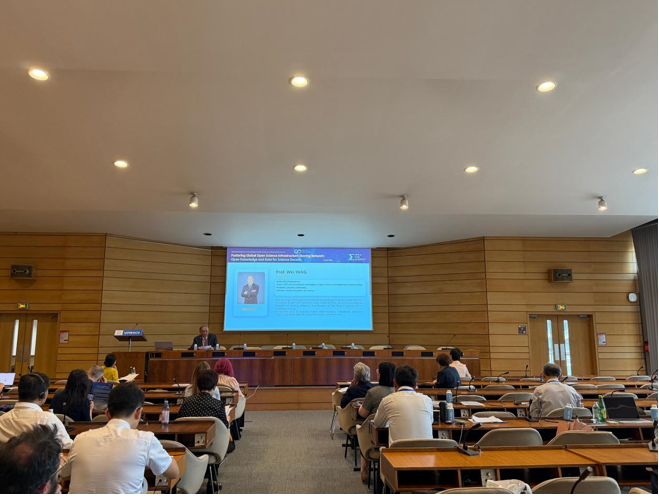
On July 16, 2026, in Paris, France, Yang Wei, Academician of the Chinese Academy of Sciences, Professor at Zhejiang University, Chair of CCOS, and lead of the OS10 Programme, chaired the open science thematic event of the UNESCO Science Decade Global Conference.
During the opening session, Luo Hui, Executive Secretary for International Affairs of the China Association for Science and Technology; H.E. Ambassador Yang Xinyu, Permanent Delegate of China to UNESCO; and Dr. Ai Sugiura, Programme Specialist for Science at the UNESCO Regional Office for East Asia, elaborated on the significance of open science in advancing global scientific cooperation and sustainable development from the perspectives of international scientific and technological cooperation, open science governance, and regional infrastructure practice.
Luo Hui said that open science is an important force driving transformation in research paradigms and global sustainable development. Through CCOS, CAST will support Chinese scientists and countries of the Global South in participating in international cooperation on open science, and promote the OS10 Programme as China’s action plan for the Science Decade. She called for building consensus on open science, developing cooperation platforms and public goods for open science, and advancing open science from ideas to connections and from shared principles to joint action.
H.E. Ambassador Yang Xinyu noted that open science is not only about open access, but also about making science more collaborative, inclusive, and accessible. She emphasized that developing countries still face gaps in scientific infrastructure, trusted data, and international research networks, and that the international community should strengthen cooperation to ensure that no one is left behind in the Science Decade.
Dr. Ai Sugiura said that East Asia has made positive progress in supporting open access publishing and building open data repositories, but still faces challenges in supporting the full research lifecycle, cross-border data interoperability, technical standards coordination, and institutional collaboration. She noted that the OS10 Programme and the Open Science Infrastructure Sharing Network Alliance (OSI4Science) can help connect fragmented platforms, promote standards coordination, and build a more inclusive global open science cooperation network.
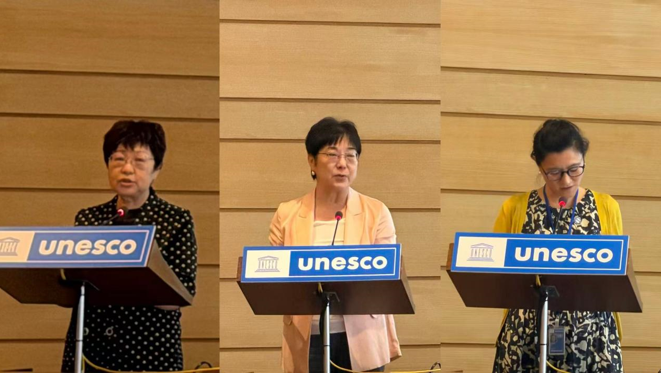
On July 16, 2026, in Paris, France, Luo Hui, Executive Secretary for International Affairs of the China Association for Science and Technology; H.E. Ambassador Yang Xinyu, Permanent Delegate of China to UNESCO; and Dr. Ai Sugiura, Programme Specialist for Science at the UNESCO Regional Office for East Asia, delivered opening remarks.
During the keynote session, Yang Wei introduced the implementation pathway of the OS10 Programme. He pointed out that, based on open science development data from 193 UN Member States, global open access levels have continued to rise, but significant gaps remain in open science infrastructure, open data, open policies, and capacity building. The OS10 Programme will advance implementation through three pillars — architecture, platforms, and monitoring — and promote open knowledge and data sharing from conceptual consensus to implementable and assessable international cooperation.
Anna Lisa Ahlers of the Max Planck Institute for the History of Science said that moving open science from consensus to practice requires not only infrastructure, but also trust, governance, inclusiveness, and long-term commitment. Liu Xiwen, Professor at the National Science Library of the Chinese Academy of Sciences, introduced the development approach of the Open Science Infrastructure Sharing Network Alliance. He said the alliance is not intended to build another isolated platform, but to serve as a distributed coordination mechanism for global open science infrastructure. Through directories, standards, interfaces, and service capabilities, it aims to connect existing platforms, promote interoperability among open science infrastructures, and support resource-constrained regions, especially the Global South, in strengthening their capacity to participate.
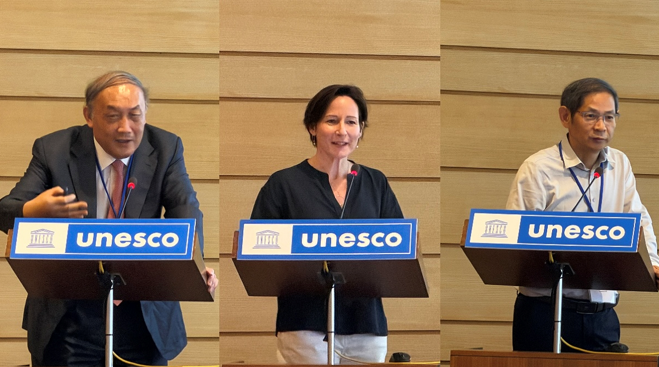
On July 16, 2026, in Paris, France, Yang Wei, Academician of the Chinese Academy of Sciences and lead of the OS10 Programme; Anna Lisa Ahlers of the Max Planck Institute for the History of Science; and Liu Xiwen, Professor at the National Science Library of the Chinese Academy of Sciences, delivered keynote speeches.
The roundtable discussion was held under the theme “Technical Pathways for Open Knowledge and Data Supporting the Science Decade Strategy.” Abel L. Packer, co-founder and director of SciELO; Giulia Malaguarnera, Outreach and Engagement Officer at OpenAIRE; Susan Reilly, member of the IFLA Advisory Committee on Open Science and Scholarship; and Niamh O’Connor, Chief Publishing Officer at PLOS, exchanged views on issues including participation of the Global South, infrastructure interoperability, the role of libraries, and innovation in open publishing models. Participants agreed that the Global South should not be merely an access point or beneficiary of open science, but should also become a co-builder of infrastructure, standards, and governance mechanisms. They also noted that the development of open science requires fairer, more diverse, and more sustainable mechanisms for knowledge dissemination and research evaluation.
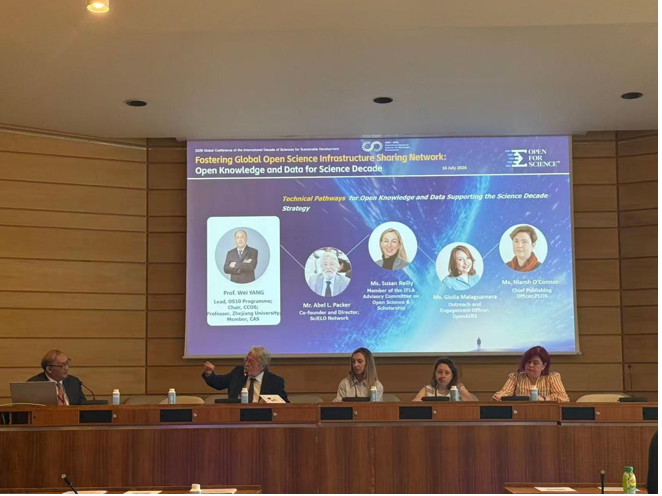
On July 16, 2026, in Paris, France, Abel L. Packer, co-founder and director of SciELO; Giulia Malaguarnera, Outreach and Engagement Officer at OpenAIRE; Susan Reilly, member of the IFLA Advisory Committee on Open Science and Scholarship; and Niamh O’Connor, Chief Publishing Officer at PLOS, participated in the roundtable discussion.
The Paris Call for Joint Action on Knowledge Sharing and Dissemination sets out four areas of action for open knowledge and data sharing: promoting the sharing and interconnection of open knowledge and data resources; coordinating the development of norms for knowledge sharing and dissemination; establishing mechanisms for contribution recognition and incentives; and carrying out collaborative, phased monitoring, assessment, and continuous improvement. The call pays particular attention to the needs and capacities of countries and regions in the Global South, and emphasizes voluntary participation, equal consultation, openness and inclusiveness, practical cooperation, and mutual benefit.
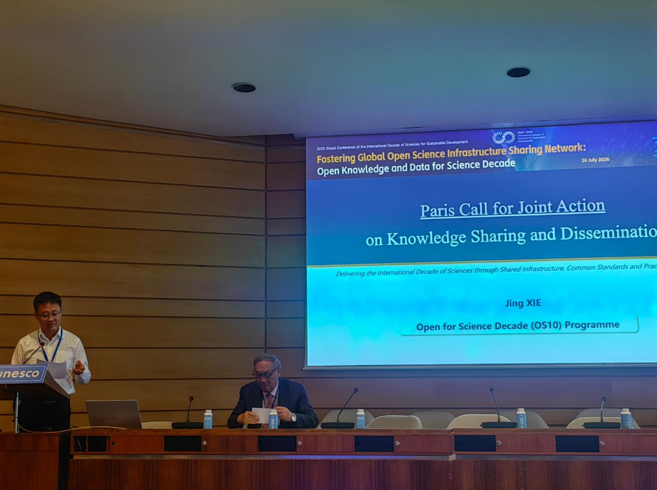
On July 16, 2026, in Paris, France, Xie Jing, Research Fellow at the National Science Library of the Chinese Academy of Sciences, released the Paris Call for Joint Action on Knowledge Sharing and Dissemination at the open science thematic event of the UNESCO Science Decade Global Conference.
Participants agreed that open science serving the Science Decade should not stop at open access, but should move toward the interconnection of open knowledge, data, platforms, standards, and services. It should not remain at the level of principled consensus, but should become an implementable, collaborative, and assessable mechanism for action. As the institutional base of the OS10 Programme Liaison Office, the National Science Library of the Chinese Academy of Sciences will work with CCOS to support coordination and implementation, and promote open knowledge sharing from international consensus to sustained action.
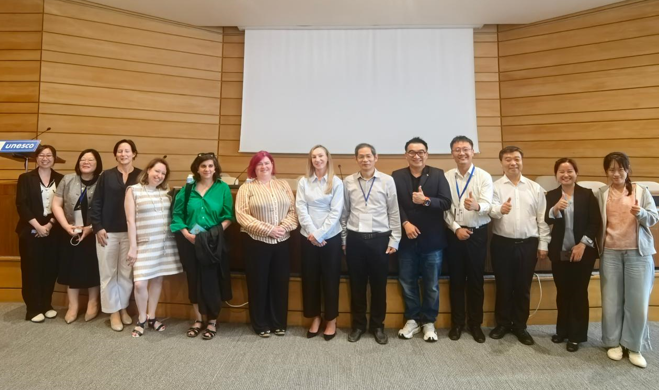
On July 16, 2026, in Paris, France, principal participants of the open science thematic event of the UNESCO Science Decade Global Conference posed for a group photo.